Sound familiar?
You’re not naive, you were busy
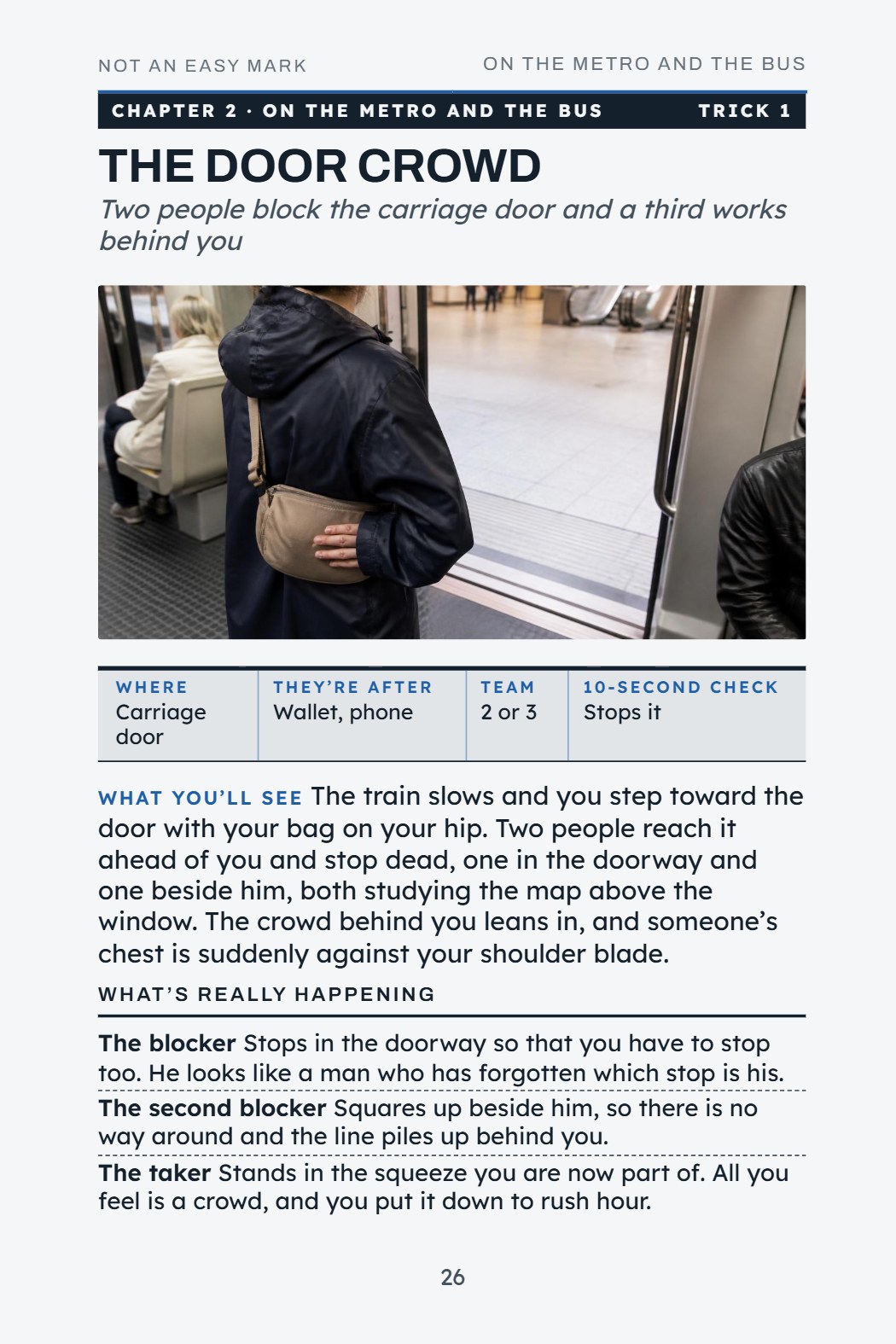
- Two people stop dead at the train door, someone presses in behind you, and only later do you find the wallet gone.
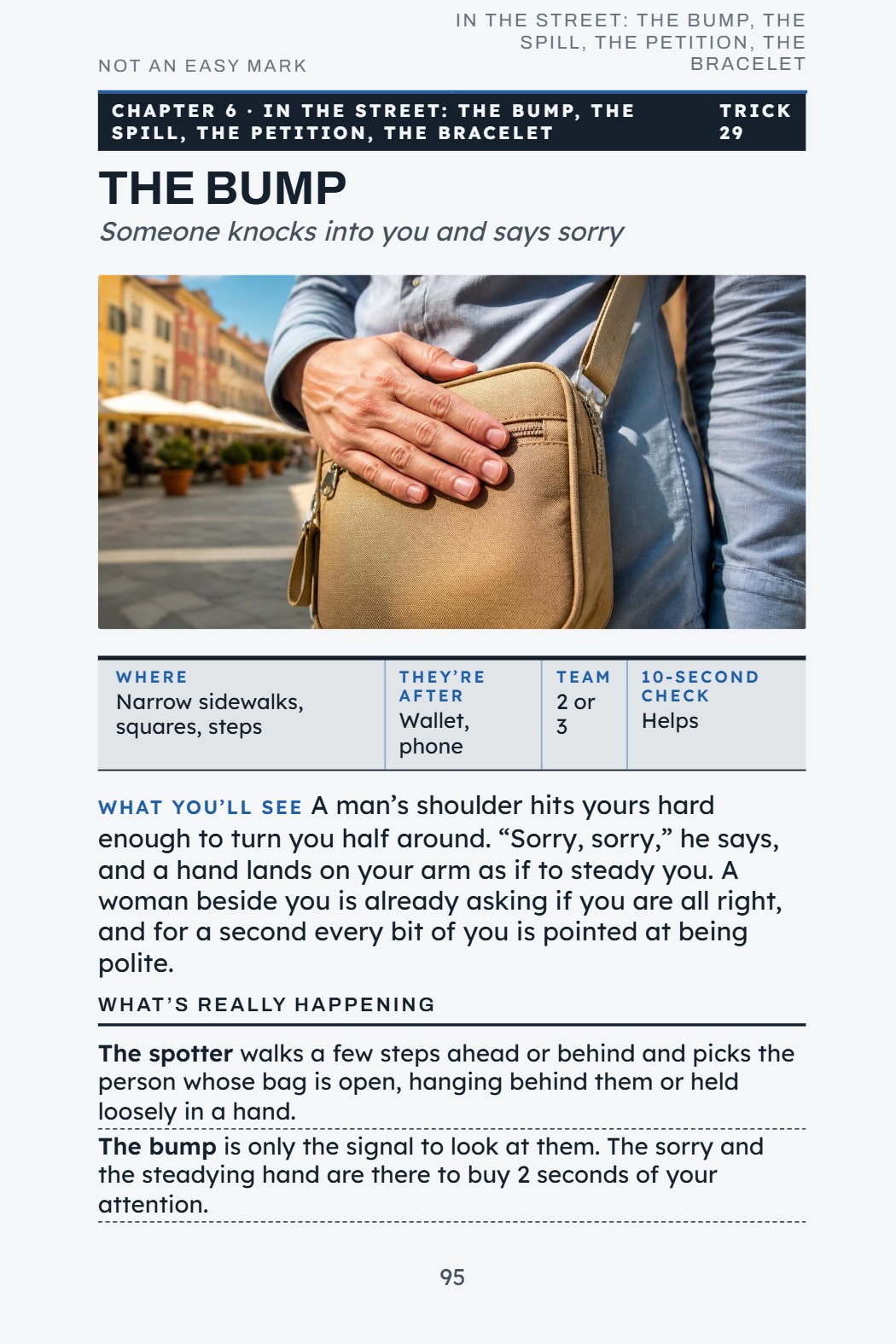
- Someone bumps you and says sorry, and you can’t decide whether to check your bag or apologize back.
- Your suitcase sits on the rack by the door, and at every stop you wonder if it’s still yours.
- You went to the police and could see straight away it wasn’t going to be productive.
- Every scam video leaves you more worried than before, and the trip of a lifetime starts to feel like guard duty.
Teams don’t pick the rich one. They pick the busy one. That’s good news, because busy is something you can fix in about ten seconds.
What you were told, and what works instead
“Keep your head on a swivel.”
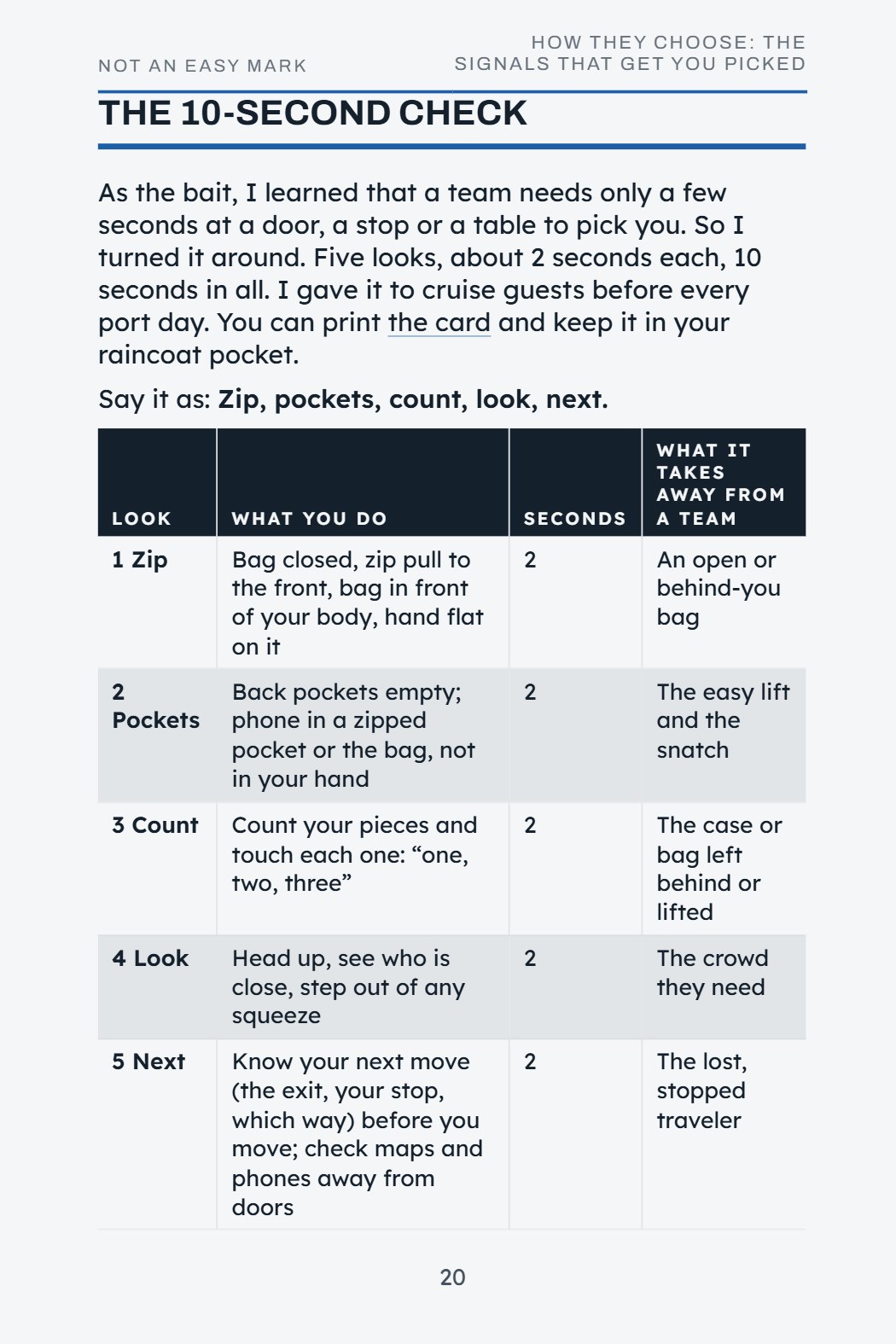
You don’t scan faces. Five looks at every door and table, about 10 seconds, and a team takes someone else. p. 20
“They go for the tourist who looks rich.”
They pick the busy one: phone in hand, bag behind you, stopped in a doorway to read a sign. p. 17
“Buy a slash-proof bag and you’re safe.”
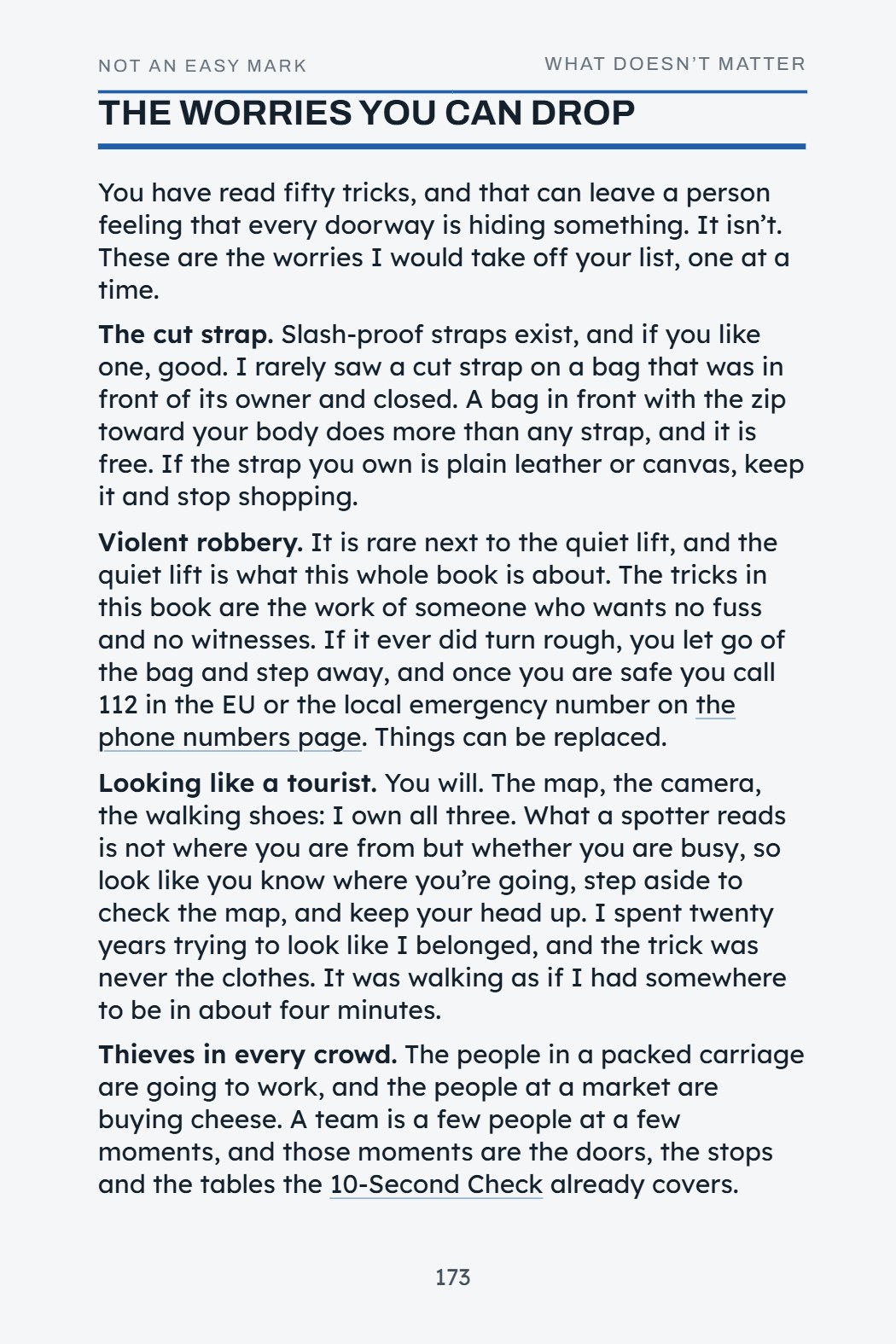
A bag in front with the zip toward you does more than any strap, and it costs nothing. p. 173
“Keep your money in a money belt.”
The belt is for the passport and a backup card. Today’s cash goes in the bag in front, so you never open the belt at a counter. p. 155
“If someone bumps you, say sorry.”
Hand flat on the bag first, step to the wall, count, then “I’m fine, thank you.” p. 160
“Go to the police and they’ll get it back.”
Lock the cards and the phone first. The police report is paperwork for your insurer and the passport. p. 166
The math
One day abroad, two ways
The day it goes wrong
- Sitting down to work the first-hour list: cards, phone, police report1 hour
- Calls to the card company, the phone carrier and the insurer3+ calls
- A new adult passport book, applied for in person, if the passport went$165
The day you do the check
- Ten checks on a full port day, 10 seconds each100 seconds
- Setting up the carry system in your room each morning2 minutes
- The book, once$27
A whole day of checks takes
100 seconds
Under 2 minutes at the doors and tables, 2 minutes in your room in the morning, and the book is $27, once.
The left column is the book’s own first-hour checklist and the US passport fee as read on travel.state.gov in October 2026 (page 166). The right column is the worked port day of the 10-Second Check (page 20). Your day will differ, and no check makes anyone theft-proof: it makes you the harder choice.
Real pages from the book
Look inside
What’s in here
Not an Easy Mark is the decoy’s way to be the harder choice: 50 tricks by where they happen, each with the one move that stops it.
| # | Chapter | Page |
|---|---|---|
| 1 | How they choose: the signals that get you picked. What a spotter reads in a glance, and the 10-Second Check that answers it | 15 |
| 2 | On the metro and the bus. Eight tricks at the doors, the stairs, the gates and the packed carriage | 24 |
| 3 | On the train and at the luggage rack. Where the suitcase goes, and seven tricks at the rack, the seat and the platform | 43 |
| 4 | At the airport and the carousel. What never goes in the hold, and six tricks from the carousel to the curb | 62 |
| 5 | At the café table and the hotel. Seven tricks at the table, the front desk, the buffet and the room phone | 77 |
| 6 | In the street: the bump, the spill, the petition, the bracelet. Nine tricks in the open: the bump, the spill, the petition, the bracelet and more | 93 |
| 7 | Cards, cash machines, taxis and money tricks. Seven money tricks: cash machines, short change, taxi meters and paying in dollars | 113 |
| 8 | Cruise ports and tour days. Six tricks from the gangway to the pier, for every port day | 133 |
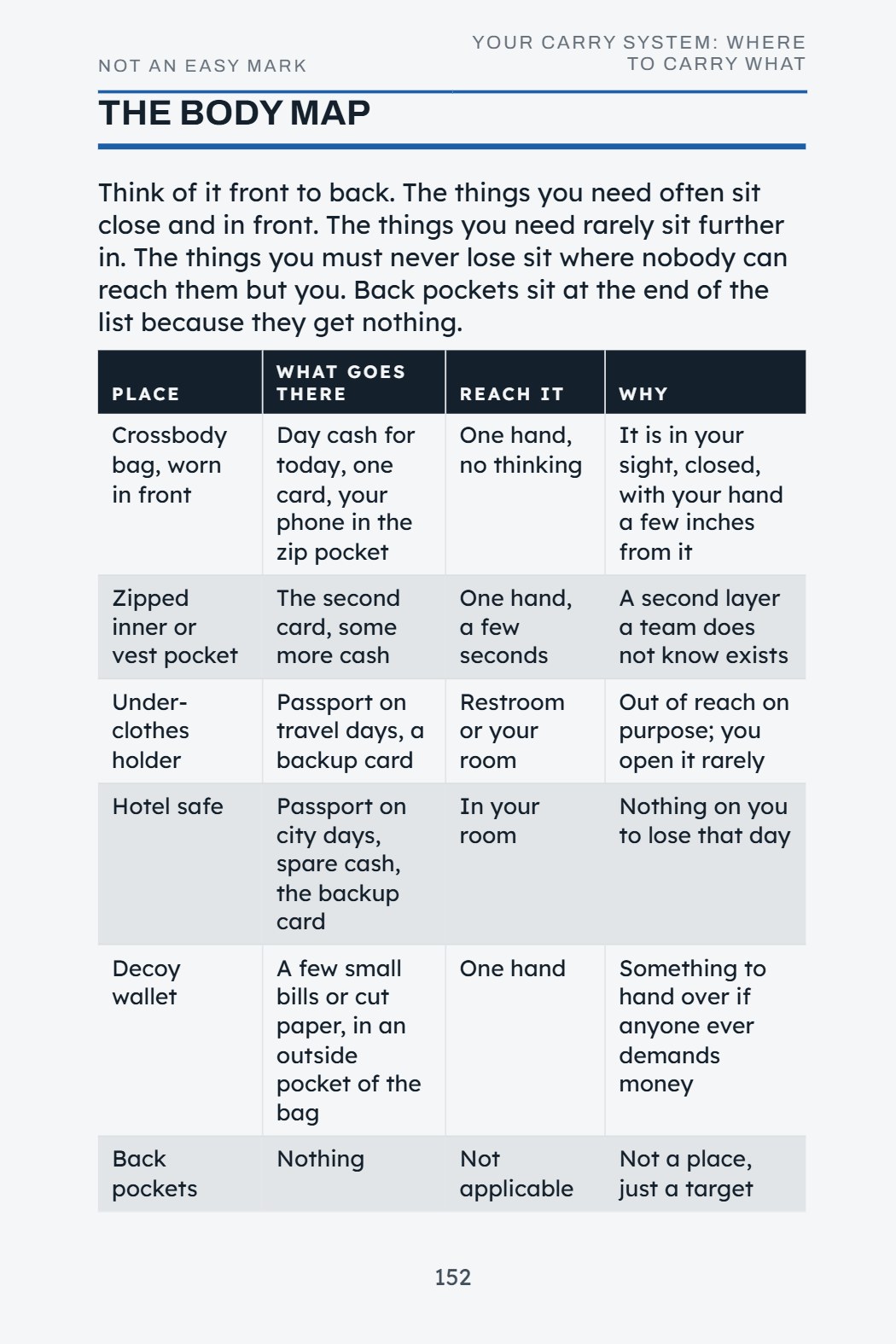
| 9 | Your carry system: where to carry what. The body map: where to carry what, and gear for older hands | 150 |
| 10 | The reflex: the second it happens. Three two-minute kitchen drills, so your hand moves before your manners | 158 |
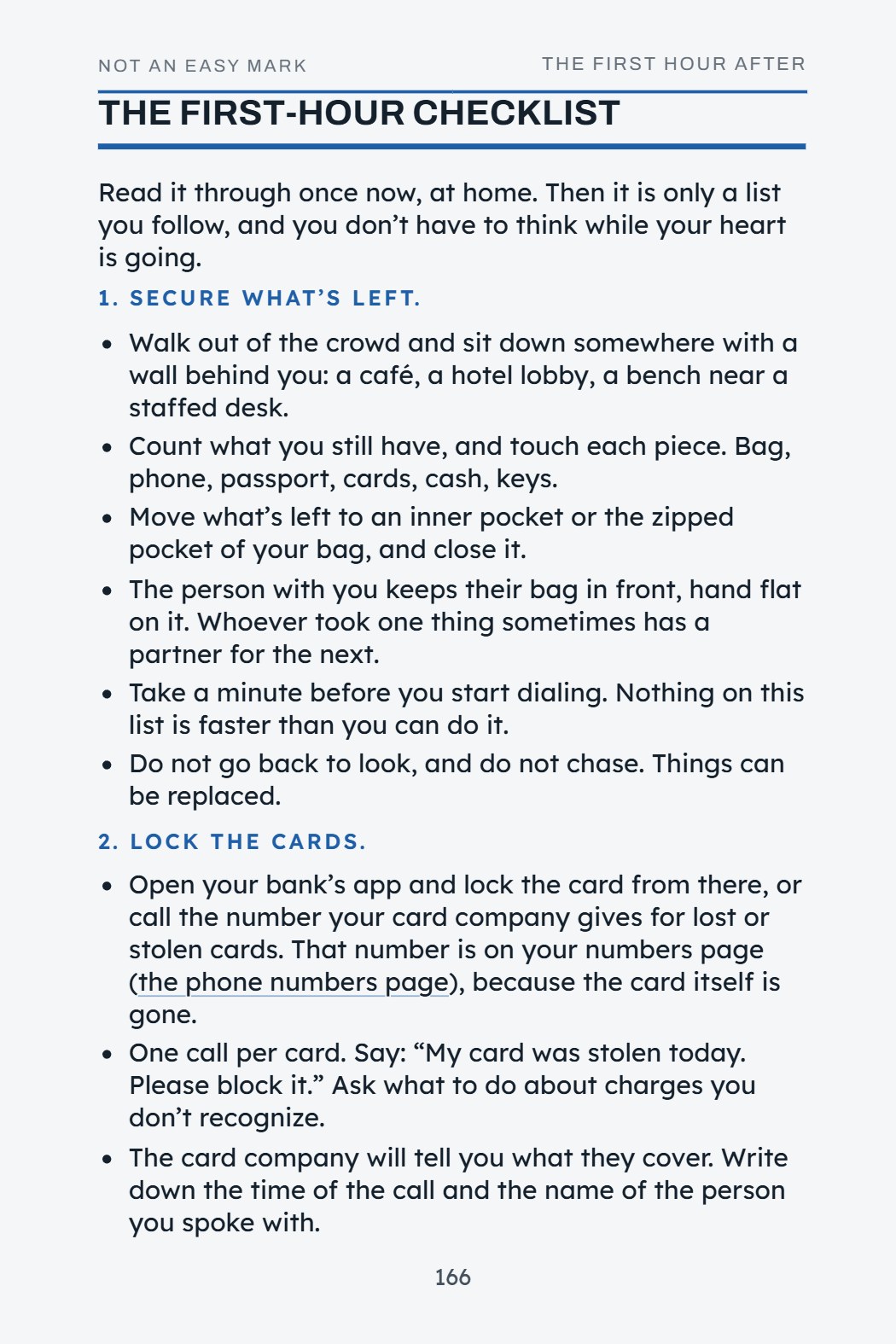
| 11 | The first hour after. Six steps in order, with the words to say on every call | 164 |
| 12 | What doesn’t matter. The worries to put down the night before you fly | 171 |
A few things you’ll find
- The two at the door and the one behind you, role by rolep. 26
- What to do the second someone bumps you, in the exact wordsp. 95
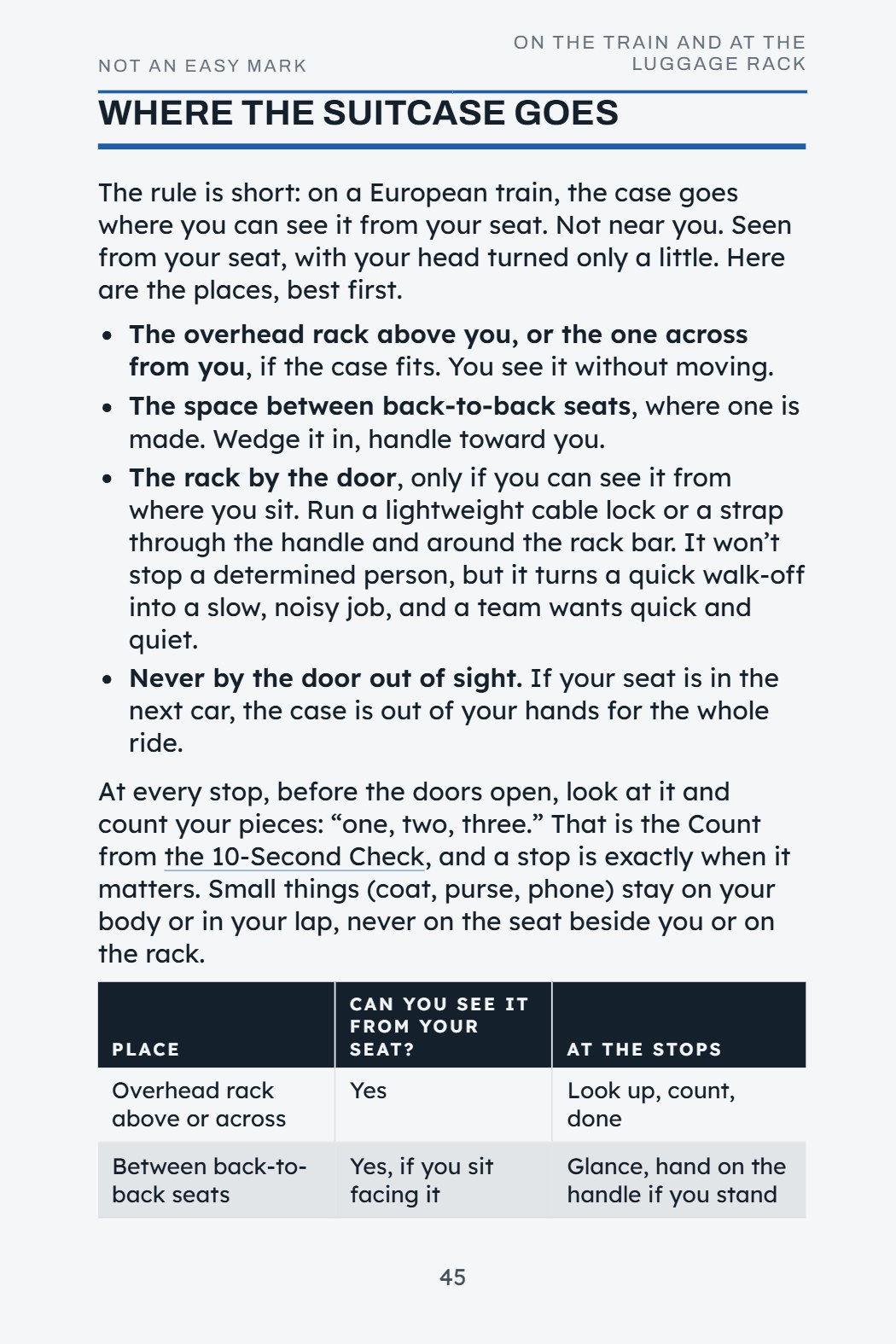
- Where the suitcase goes on a European train, and what to do at every stopp. 45
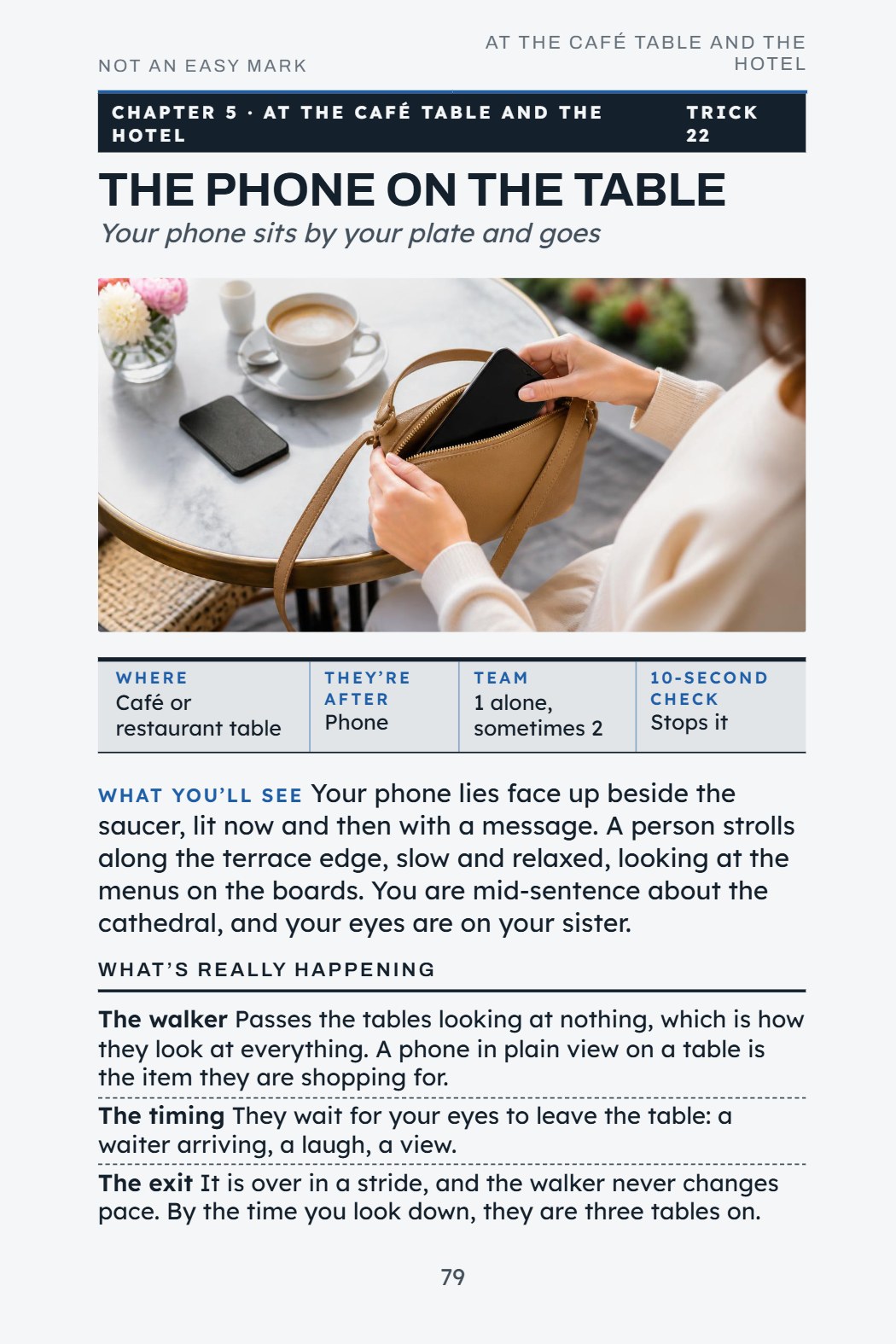
- Why the phone by your plate is the first thing they look atp. 79
- What to say when the card machine offers to charge you in dollarsp. 128
- The “police” who ask to check your walletp. 130
- The free sprig of rosemary that comes with a billp. 146
- The late call from “reception” asking you to confirm your cardp. 91
Plus the 10-Second Check card, the first-hour sheet with blanks to fill in and the phone numbers page, all made to print, and an index by what they’re after: wallet, phone, bag, suitcase, passport.
How I came to write this
Twenty years as the bait
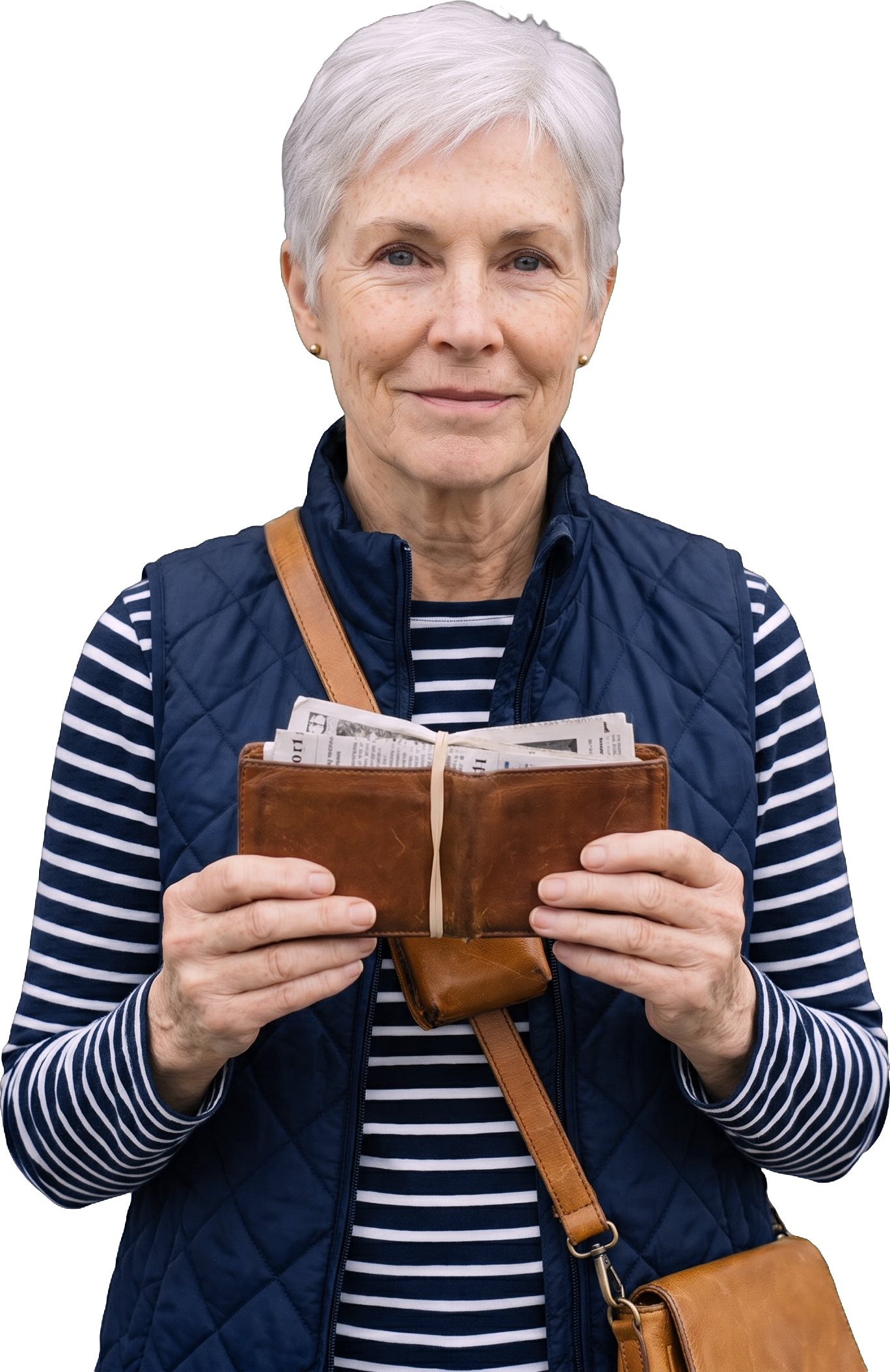
My sergeant picked me when I was 25. He looked me up and down and said, “You always look like you’re late for something. You’re the bait.”
For twenty years I was the decoy on a big-city transit police pickpocket squad. I rode the trains and the airport line looking busy, with a wallet where a thief could see it, while my partner Sal watched who came for it. My job was to be chosen. So I learned how choosing works.
Then I spent twelve years as a guest safety lead for a cruise line in Europe, briefing guests before every port day and sitting with them in the first hour after, when something had gone. Lovely people, most of them retired. Not one of them was foolish. They were busy, looking at the cathedral, which is what you’re supposed to do.
That’s where the 10-Second Check came from: a team needs a few seconds, so I gave my guests ten seconds of their own. My sister Maureen, who carries her purse like a lunchbox, kept saying, “Write it down, Dot, so I can stop asking you.” So here it is. Go. Just go smart.
Dot Kavanagh
Who it’s for, and what it won’t do
It’s for you if
- You’ve traveled for years and want to stay the harder choice on the next trip.
- You’re planning a European trip, a cruise or a tour, with trains, metros and port days.
- You’d like a short routine instead of being on guard all the time.
- You travel alone, or with a spouse or a sister who carries her purse like a lunchbox.
- You want to know exactly what to do in the first hour if something goes.
It’s not for you if
- You want gear reviews or brand names. Gear is described by type, and most of the moves are free.
- You’re looking for self-defense. The move is always to protect, step away and report, never to fight.
- You want a promise that nothing can ever happen. No book can make anyone theft-proof. This one makes you a harder choice.
Not legal, insurance or medical advice
For those, the book tells you who to call: the card company, the insurer, the embassy or consulate, and 112 anywhere in the EU.
Fees and rules change
Passport rules, fees and phone numbers are as of October 2026. The official sites named in the book have the last word.
Get Not an Easy Mark
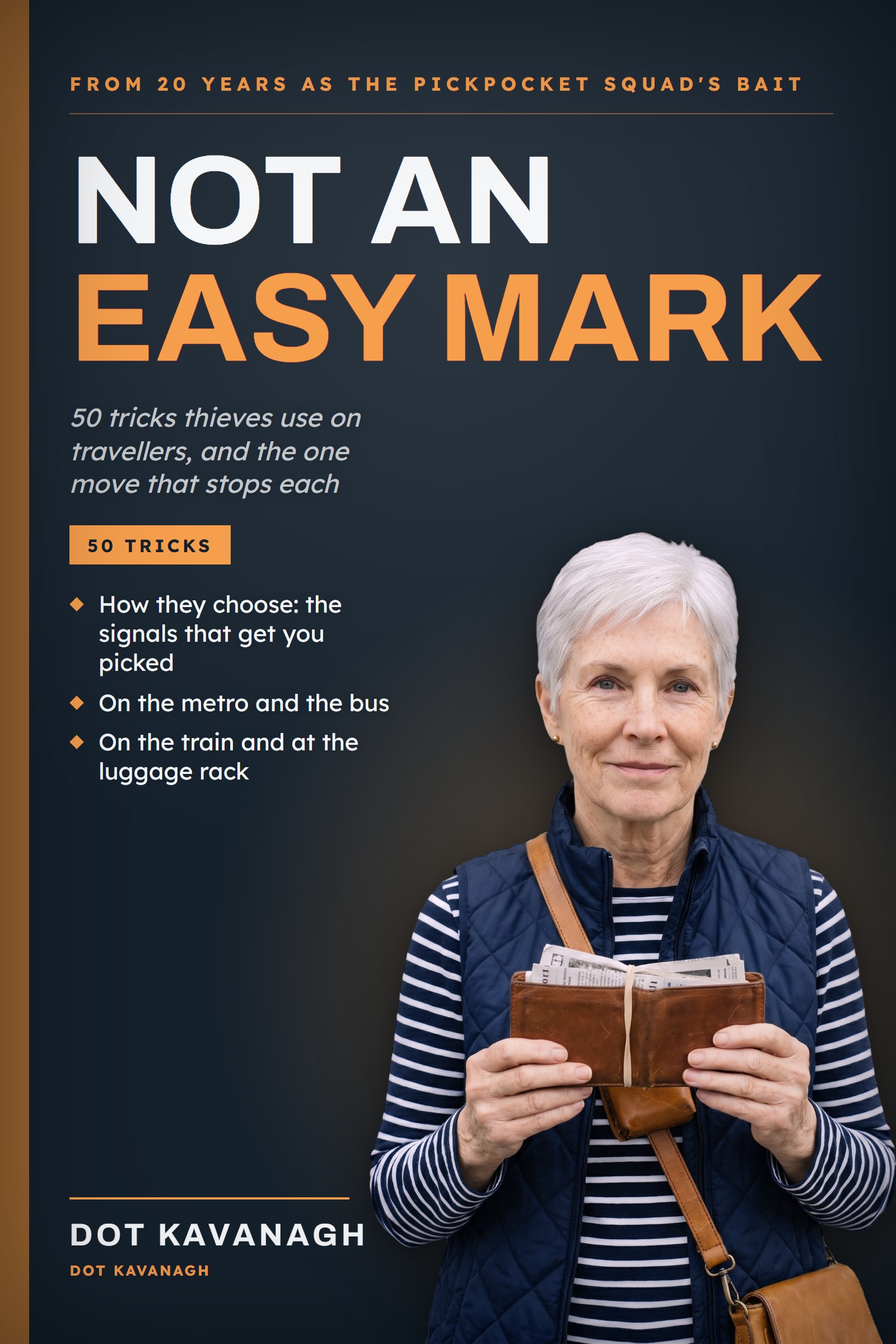
Not an Easy Mark
- 50 tricks in 12 chapters, each told from the thief’s side, with the one move that stops it
- The 10-Second Check: five looks you can do with a coffee in your hand, and how it does against all 50 tricks
- The exact words to say to the clipboard, the spill and the helper at the machine
- The body map and gear for older hands, so you can reach your money without undressing
- Three two-minute drills to practice in your kitchen before you fly
- The first-hour checklist: six steps, in order, with what to say on every call
- Printables: the 10-Second Check card, the first-hour sheet and the phone numbers page
- PDF + EPUB, for phone, tablet, computer or e-reader
🔒 Secure checkout by Gumroad · Card · Apple Pay · Google Pay · PayPal
Right after you pay, the download page opens and the link comes by email. Start on page 20: the 10-Second Check takes five minutes to learn, and you can use it at the very next door.
The Port Day Promise
Read it for 30 days. If it doesn’t make you calmer on your next trip, write to me and you’ll get every penny back. No questions, and you keep the book.
Questions travelers ask
I’ve traveled for decades and never had a problem. Is this for me?
Good, keep it that way. Most of these tricks are aimed at experienced travelers who are busy, not new ones who are careful. The check takes ten seconds and helps keep your record clean.
I’m a New Yorker. Isn’t it the same everywhere?
Plenty of it is. The difference on a trip is that you’re carrying more, reading signs and stopping in doorways. Those are the signals a team reads, and the book shows each one.
Won’t this just make me more worried?
No. It’s told from the thief’s side, with proportion. The last chapter is a list of worries you can drop, and the check is short enough that you stop noticing you do it.
Do I need to buy special gear?
No. Most of the moves are free. Where gear helps, I describe the type, never a brand, and what to skip.
Can someone cut the strap and take the whole bag?
It happens, but I rarely saw it on a bag worn in front and closed. A bag in front with the zip toward you does more than any strap. Page 173 has the rest.
What if my passport is stolen?
The first-hour checklist takes you through it in order: the cards, the phone, the police report, then the embassy, with the fee and the State Department’s 24-hour numbers.
Can I read it on my phone, or print it?
Both. It’s a PDF and an EPUB for phone, tablet, computer or e-reader, and the card and sheets at the back print on ordinary letter paper.
Why is there a clock on the price?
The launch price of $27 is held for you for 20 minutes from your first visit. After that, the book is $37. The 30-day promise is the same either way.
Go. Just go smart.
50 tricks from the thief’s side, each with the one move that makes them pass you by, and a plan for the first hour if a day ever goes wrong.
They don’t pick the rich one. They pick the busy one.
P.S. If you read only one page before your trip, make it the 10-Second Check on page 20. And if the book isn’t for you, every penny comes back.